What Is the Life Cycle of Cabbage White Butterflies? Egg to Adult
What is the life cycle of cabbage white butterflies? Pieris rapae goes through four stages, egg, caterpillar, chrysalis, and adult, and a female can complete the whole cycle in about a month during warm weather. The species is native to Europe and North Africa but has spread across North America since the 1860s, and it's now one of the most common butterflies in home gardens.
Where Cabbage Whites Lay Their Eggs
Cabbage whites belong to the family Pieridae. The caterpillars feed almost exclusively on plants in the mustard family, Brassicaceae, which is why gardens growing cabbage, broccoli, kale, and collards attract them so reliably. Females key in on mustard-oil compounds in these plants (glucosinolates) to decide where to lay.
Stage 1: The Egg
Each egg is oblong, pale yellow, and ridged lengthwise, more like a tiny ribbed football than a sphere. A female lays them one at a time, almost always on the underside of a leaf.
How Many Eggs and Where
- Timing: Egg-laying runs from early spring into fall, with several generations produced along the way.
- Placement: Eggs go on leaf undersides, singly rather than in clusters, which spreads the risk if a predator finds one.
- Total: A female can lay 300 to 400 eggs over her lifetime, according to the University of Michigan's Animal Diversity Web.
Hatching
Eggs hatch in roughly a week under normal spring conditions. Cooler weather slows this down; a stretch of cold nights can push hatching out several extra days.
Stage 2: The Caterpillar
The newly hatched caterpillar is small enough to be easy to miss, but it starts eating immediately and doesn't stop until it's ready to pupate.
What the Caterpillar Looks Like and Does
- Appearance: The caterpillar is velvety green with a faint yellow stripe down its back, camouflaged well against brassica leaves.
- Feeding pattern: It chews in a circular pattern, leaving round holes rather than ragged edges, and its droppings can stain and contaminate the outer leaves.
- Growth: The caterpillar passes through five instars separated by four molts, growing from a few millimeters to roughly an inch and a quarter.
Duration
The larval stage runs about two to three weeks. Broccoli and cauliflower can tolerate a fair amount of outer-leaf feeding, but damage to cabbage and collard heads cuts directly into yield since gardeners eat the part being chewed.
Stage 3: The Chrysalis
Once it has eaten enough, the caterpillar stops feeding and wanders off the host plant, sometimes several feet, to find a stem, fence post, or wall to pupate on.
Forming the Chrysalis
- Anchoring: The caterpillar spins a silk pad and a thin silk girdle to hold itself upright against the surface it has chosen.
- Color: The chrysalis itself is angular and mottled green, brown, or gray, matching whatever background it formed against.
What Happens Inside
Inside the case, most larval tissue breaks down and is rebuilt into adult structures, wings, legs, antennae, and reproductive organs, in a process called histolysis and histogenesis.
Duration
A summer chrysalis lasts 11 days to a few weeks. The species overwinters as a pupa: fall-generation caterpillars form a chrysalis that enters diapause and doesn't emerge until spring temperatures rise, per Purdue University's Vegetable Crops Hotline.
Stage 4: The Adult Butterfly
The adult that breaks free of the chrysalis looks nothing like the caterpillar that built it.
Emergence
- Timing: Adults typically emerge in the morning, when temperatures are mild enough to fly but predators are less active.
- Wing expansion: The wings start crumpled and wet; the butterfly pumps hemolymph into the veins to expand them, then waits for them to dry and harden before its first flight.
What Adults Look Like
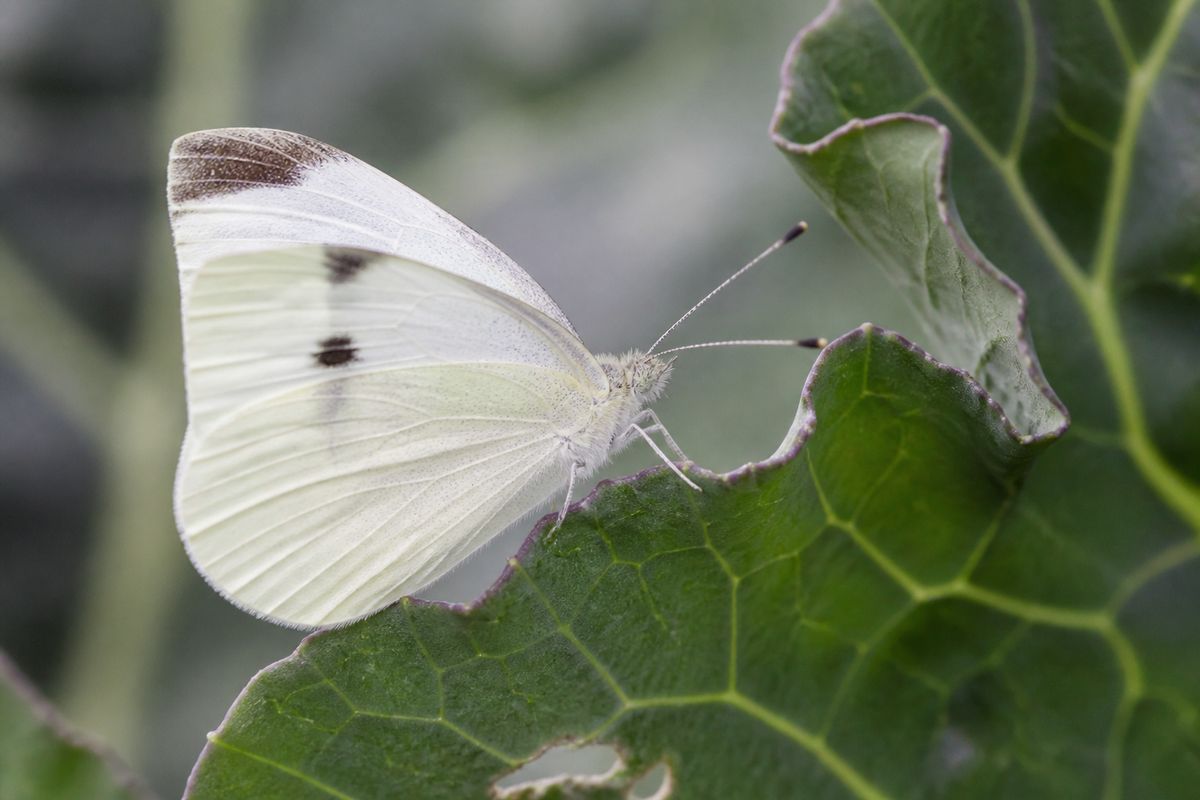
Cabbage whites are white with black wingtips; females also carry two black spots on each forewing, males one. Wingspan runs from about 1.3 to 1.9 inches, and spring-generation adults tend to run smaller than summer ones.
How Long Adults Live
An adult typically lives a few weeks, with females living up to about three weeks, depending on weather. Purdue notes the species completes three to five generations a year across much of its range, with more generations in warmer climates.
Why This Butterfly Matters in the Garden
Cabbage whites cut both ways for a home garden.
Pollination
Adults visit a wide range of garden flowers for nectar and move pollen between blooms as they feed, the same way most butterflies do.
Crop Damage
The caterpillars are the actual pest: their circular feeding pattern and droppings are what show up on cabbage, kale, and broccoli. Exclusion netting placed right after transplanting, and weekly Bacillus thuringiensis applications once larvae appear, are the two most reliable non-chemical controls.
Natural Predators
Parasitic wasps and tachinid flies attack the caterpillars, but Purdue's extension entomologists note these natural enemies alone usually aren't enough to keep populations below damaging levels on a vegetable crop.
A Few More Facts
Sex is visible in flight: males have one forewing spot and appear slightly whiter; females have two spots and often look a touch more cream-colored.
It's an introduced species in North America: Pieris rapae arrived in Quebec around 1860 and spread across the continent within a few decades.
Single eggs, not clusters: unlike many moths, a female never lays more than one egg per spot, which is why you'll rarely find a dense cluster on one leaf.
Diapause is facultative: only the generation heading into fall enters the dormant, overwintering pupal stage; summer generations pupate and emerge within weeks.
They're strong fliers for their size: cabbage whites will readily cross open ground between garden plots and wild mustard patches, which is part of why they're so widespread.
Managing Cabbage Whites in Your Garden
If you're growing brassicas, expect this butterfly. Check leaf undersides for the ridged yellow eggs starting in early spring, and handpick or net before caterpillar numbers build. Knowing the four-stage cycle, egg, caterpillar, chrysalis, adult, tells you exactly when intervention is cheapest: once caterpillars reach their fifth instar, they've already done most of their feeding damage.