How to Spot Click Beetles in the Wild: The Clicking Spine Test
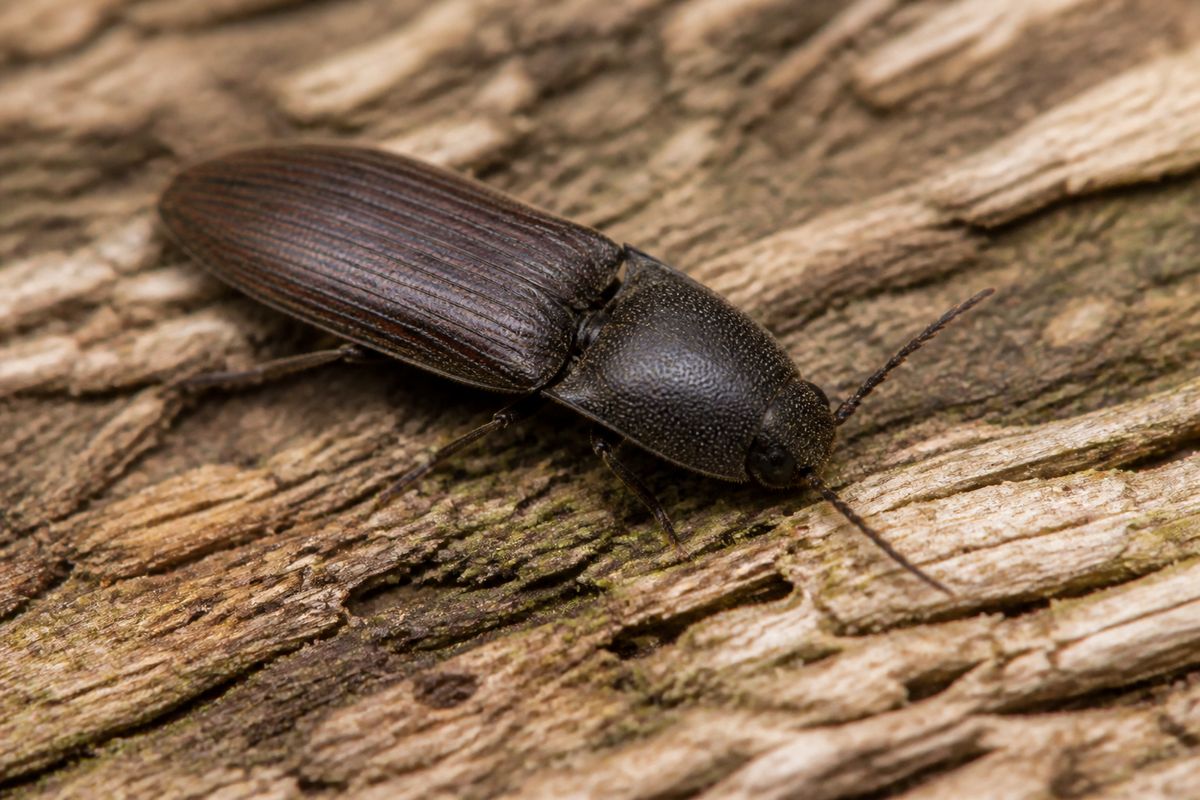
How to spot click beetles in the wild comes down to one trick: flip a suspect over. Elateridae is a family of roughly 10,000 species worldwide, and nearly all of them share a spring-loaded thorax that snaps them upright with an audible click when they're stuck on their backs. Once you know what to look for, they turn up almost anywhere there's leaf litter, rotting wood, or a porch light left on after dark.
What Sets a Click Beetle Apart
A few traits separate click beetles from other beetles at a glance:
- Body shape: Elongated and somewhat flattened, with a hard exoskeleton and a pointed rear end. North American species range from a few millimeters up to the eyed click beetle (Alaus oculatus), which reaches 2.5 to 4.5 cm and is the largest in the family here.
- Coloration: Black, brown, gray, or metallic, often with mottling. Alaus oculatus is mostly black with two bold white-speckled false eyespots on the pronotum, which is one of the easier field marks in the group.
- Life cycle: Complete metamorphosis from egg to larva (wireworm) to pupa to adult. The larval stage can run one to several years underground before an adult ever emerges.
Habitat and Timing
Click beetles turn up in woodlands, grasslands, gardens, and farm fields, anywhere organic matter is breaking down. Adults are usually found near plants or under bark, while larvae live in soil, rotting logs, and other protected spots. Most species are active from spring through fall and are nocturnal as adults, so a flashlight or porch light after dark often turns up more individuals than daytime searching.
Where to Look
- Leaf litter and ground cover: Search under logs, stones, and fallen leaves where adults shelter during the day.
- Foliage and flowers: Check leaves and blooms; many adults feed on nectar and pollen in warm months.
- Rotting wood and bark: Pry back loose bark or check damp, decaying logs, prime ground for both larvae and sheltering adults.
- Lights at night: Run a flashlight or leave a porch light on; nocturnal adults are drawn to artificial light.
Identifying Click Beetles Up Close
Size and Shape
Most species you'll find in a yard or field run 5 to 20 mm long, though the family spans a much wider range. Body outline varies from narrow and cylindrical to broad and flattened depending on the species, so shape alone won't nail an ID, but it narrows the search.
Elytra and Color Pattern
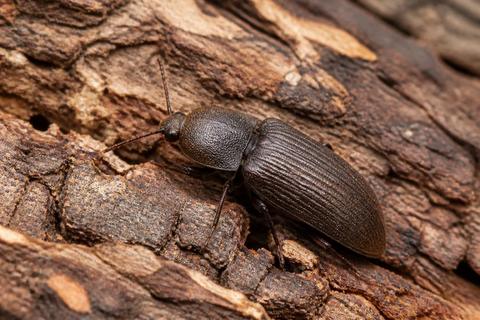
Look closely at the wing covers (elytra): some are smooth, others finely ridged or granular, and they typically meet in a straight line down the back. Coloration ranges from solid black or brown to mottled or striped patterns that can help separate look-alike species in the same habitat.
Antennae
Click beetle antennae are usually made up of 11 segments and are threadlike, saw-toothed, or comb-like depending on the species and sex. Length and shape are a secondary clue once body size and color have narrowed the possibilities.
The Click Mechanism
This is the definitive test. A blunt spine on the underside of the prothorax fits into a slot on the mesothorax; when the beetle flexes and the spine releases, it snaps the body upright with an audible click and enough force to flip the beetle into the air. Turn a suspected click beetle onto its back: if it arches, snaps, and pops upright, the ID is confirmed. No other common beetle family does this.
Feeding and Reproduction
What They Eat
Adult diets vary by species: many feed on nectar and pollen, while others eat little as adults and rely on fat reserves from the larval stage. Larval diets vary just as widely across the family. Some wireworms eat decaying material in rotting logs or soil, while others feed on seeds, sprouts, and plant roots, and a smaller number, including Alaus oculatus larvae, are predators that hunt other beetle larvae and soft-bodied insects underground.
Courtship and Eggs
Males fly in search of females during warmer months, and mated females lay eggs in moist soil or leaf litter near a food source the larvae will need once they hatch. Because the larval stage can last more than a year, the adults you spot clicking in June may represent eggs laid two summers earlier.
Predators and the Click as Defense
Birds, shrews, and other insects prey on click beetles. The click-and-flip response is primarily an escape mechanism: it rights the beetle instantly and can startle or dislodge a predator that has it pinned, buying just enough time to get away.
Field Tips for Finding Them
- Check multiple habitats: Forest edges, gardens, and farm fields each tend to host different species mixes.
- Search dawn, dusk, or after dark: Activity peaks outside the heat of midday, and nocturnal species only show up once the sun is down.
- Try a light trap: A simple sheet and lamp at night draws in species you'd rarely see by day.
- Flip anything you find on its back: If it doesn't click and right itself, it isn't an elaterid.
A Few North American Species to Know
Eyed Click Beetle (Alaus oculatus)
The largest click beetle in North America at 2.5 to 4.5 cm, black with two large white-speckled eyespots on the pronotum that likely startle predators. Larvae are opportunistic predators; researchers have recorded a single larva consuming roughly 200 long-horned beetle larvae over its development.
Firefly Click Beetles (Pyrophorus spp.)
Found through tropical and subtropical parts of the Americas, these bioluminescent click beetles carry two glowing spots on the pronotum plus a brighter light organ on the underside of the abdomen, and unlike fireflies, they glow continuously rather than flashing.
Common Wireworm-Producing Species
Several smaller, drab brown or gray species in genera such as Melanotus and Agriotes are the ones most likely to turn up in a vegetable garden or lawn, since their wireworm larvae feed on roots and are frequently dug up while gardening.
Handle Them Carefully
Click beetles are harmless to handle and won't bite or sting. Observe them where you find them, photograph the elytra and pronotum for later identification, and return any beetle you pick up to the spot where you found it. A population of wireworms in a garden bed is a sign of an active soil food web, not necessarily a pest problem, since most species outside a handful of agricultural pests do little to no damage as adults.