The Evolution of Parental Care in Insect Species
The evolution of parental care in insect species runs from total neglect, most insects lay eggs and leave, to elaborate biparental partnerships that rival birds and mammals. Over a million described insect species show almost every possible level of investment in between, shaped by predation, food scarcity, and how stable the habitat is from one generation to the next.
Direct and Indirect Care
Entomologists split parental care into two categories. Direct care means active contact with the young: guarding eggs, feeding larvae, or moving them to safer spots. Indirect care means improving the odds without touching the offspring at all, digging a nest chamber, choosing a carcass or dung pat in a low-competition spot, or provisioning a burrow before eggs are even laid.
The Default: No Care at All
Most insect lineages never evolved past the ancestral pattern: a female lays hundreds or thousands of eggs and abandons them. A single American cockroach female produces roughly nine to ten egg cases over her lifetime, each holding 14 to 16 eggs, betting on volume rather than protection. Mortality is steep, but the strategy costs the parent almost nothing metabolically, which is why it remains the majority approach across Insecta.
What Pushes a Lineage Toward Care
Predators at the Egg Stage
When egg or larval predation is heavy, staying nearby to fight off ants, wasps, or other beetles raises survival enough to offset the cost of guarding. Several carrion and dung beetles stand over their brood for days rather than dispersing after laying.
Patchy or Contested Food
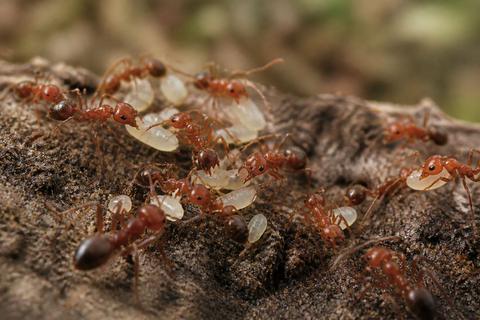
Where a larval food source is valuable and hard to defend, a carcass, a dung ball, a rotting log, parents that stay and guard it out-reproduce parents that don't. Ants carry food back to the nest and feed it directly to larvae, a level of provisioning only possible because the colony defends a fixed, contested resource.
Habitat Predictability
In stable habitats, investing heavily in a small number of offspring can outperform scattering eggs widely. In unpredictable ones, the reverse holds: cheap, abundant eggs are a better hedge than a parent's time.
Burying Beetles: Biparental Care Over a Carcass
Burying beetles (genus Nicrophorus) show one of the most striking cases of insect parental care. A mated pair finds a small vertebrate carcass, a mouse or a songbird, strips the fur or feathers, coats it in antimicrobial secretions, and buries it as an underground larval nursery. In Nicrophorus orbicollis, researchers tracking 112 breeding pairs found that 66.1% of broods were raised by both parents rather than one, and two-parent broods produced more surviving offspring than single-parent ones. Larvae beg at the carcass and are fed regurgitated, predigested carrion until they disperse to pupate in the surrounding soil.
Colony-Level Care: Ants and Honeybees
Social insects turn parental care into a division of labor. In a honeybee colony, nurse workers, not the queen, feed larvae and keep the brood nest within a narrow band; honeybee brood needs the nest held between roughly 33°C and 36°C for normal development, and workers cluster, fan, or generate heat as "heater bees" to hold that range through summer and winter. Ant colonies run a similar system: foragers return food to the nest and trophallaxis (mouth-to-mouth food transfer) moves it to larvae, so provisioning happens continuously rather than in one egg-laying event.
Protected Eggs: The Cockroach Ootheca
Not every form of care involves ongoing contact. Female cockroaches produce an ootheca, a hardened, ridged egg case, and either carry it externally until just before hatching or retain it internally depending on species. The casing itself is the investment: it shields the eggs from desiccation and small predators without the mother having to guard a nest site.
Paternal Guarding
Maternal care dominates across Insecta, but males contribute directly in some groups. Male burying beetles help defend the carcass and can raise a brood alone if the female is lost. In certain treehoppers and assassin bugs, males guard egg masses or nymphs against predators and parasitoid wasps while females forage or lay additional clutches elsewhere.
The Costs of Staying
Energy Diverted From Future Broods
Time spent guarding or provisioning is time not spent foraging or mating again. In species with only one or two reproductive bouts per season, that tradeoff can cap lifetime offspring number even as it raises survival within a single brood.
Exposure to the Same Predators
A parent guarding a nest or carcass is a stationary target. Burying beetles lose broods to conspecific intruders that try to take over a prepared carcass, and defending against them carries real injury risk.
Conflict Between Parents and Among Broods
In biparental species, partners don't always agree on how much effort to invest, and one parent deserting shifts the full burden to the other. Dominant males in some species gain more mating opportunities but also draw more contests over shared broods.
Open Questions
-
Genetics of care behavior: which genes turn guarding or provisioning on, and how conserved are they across beetle, hymenopteran, and blattid lineages that evolved care independently.
-
Climate and habitat shifts: whether warming or habitat loss is pushing species toward or away from parental investment as resource patchiness changes.
-
Cross-taxon comparison: how insect care strategies (carcass provisioning, colony-level brood tending, protective egg cases) map onto the same tradeoffs seen in fish, birds, and mammals.
Independent Origins, Same Pressures
Parental care evolved separately in beetles, roaches, and social hymenopterans, not from a shared ancestor with parental instincts, but because the same pressures, hungry predators, contested food, and unpredictable habitats, kept selecting for it. That convergence is the clearest evidence that care pays for itself often enough, across a group as varied as insects, to be worth the cost.
Sources
- Biparental care is predominant and beneficial to parents in the burying beetle Nicrophorus orbicollis (Biological Journal of the Linnean Society, via PMC/NCBI, peer-reviewed)
- Honeybee Colony Thermoregulation - Regulatory Mechanisms and Contribution of Individuals in Dependence on Age, Location and Thermal Stress (PMC/NCBI, peer-reviewed)
- University of Florida Entomology and Nematology Department - American cockroach, Periplaneta americana