Discovering Rare and Exotic Moths: Atlas to White Witch
Discovering rare and exotic moths starts with looking past the porch light. Moths outnumber butterflies roughly nine to one within the order Lepidoptera, and the group ranges from moths small enough to mine a single leaf to giants with foot-long wingspans. This guide profiles five standout species, the habitats that produce the most unusual finds, and practical ways to observe moths without disturbing them.
Macromoths and Micromoths
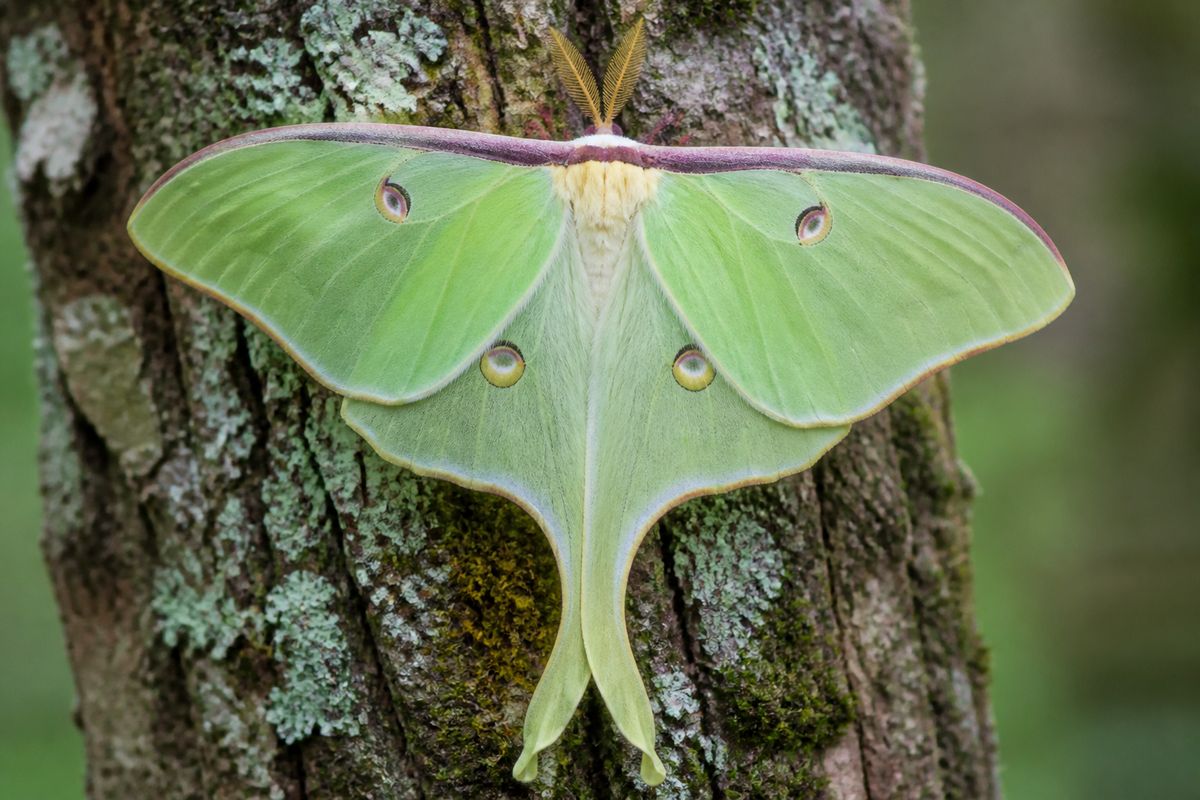
Moths split into two rough camps: macromoths and micromoths. Macromoths are the ones people notice, saturniids like the Luna Moth and Atlas Moth with wingspans measured in inches. Micromoths are smaller, often under half an inch, and identifying them usually means checking wing venation or genitalia under magnification rather than relying on color pattern alone.
Attacus atlas, described below, is a macromoth. So is Hyalophora cecropia. Micromoths make up the majority of species but rarely appear in field guides aimed at beginners, which is part of why so many remain undescribed.
Why Rare Moths Matter Ecologically
Moths pollinate at night, when bees and butterflies are inactive. Because many moth species have narrow habitat tolerances, a population crash in a given area often shows up before other, more visible signs of habitat loss or pesticide drift. Some rare species also carry adaptations, like the Atlas Moth's snake-mimic wingtips, that reveal how predator pressure shapes wing pattern over generations.
Five Notable Rare and Exotic Moths
Atlas Moth (Attacus atlas)
The Atlas Moth reaches a wingspan of about 10 inches (25 cm) and ranges across South and Southeast Asia, from India to the Philippines and south into Indonesia. Its wingtips are shaped and colored to resemble a snake's head, a pattern that likely deters birds. Adults have no functional mouthparts; they live on fat reserves stored during the larval stage and survive roughly one to two weeks. Deforestation across its native range is the main pressure on populations.
Cecropia Moth (Hyalophora cecropia)
North America's largest native moth, with wingspans documented over 6.2 inches, the Cecropia is easy to identify by its red body, white collar, and eyespotted wings. Caterpillars feed on maple, cherry, and birch, spin a tough cocoon in late summer, and overwinter as pupae before emerging the following spring. It is not federally listed as threatened, but local populations decline where host trees are removed.
Gynandromorph Moths
Gynandromorphism produces individuals with both male and female tissue, often visible as a wing that is split down the middle between male and female coloration. It has been documented across multiple moth and butterfly families, including the Nymphalidae, and results from an error during early cell division rather than any environmental cause. Specimens are prized by collectors precisely because the split pattern is unrepeatable.
White Witch (Thysania agrippina)
Found from Mexico south to Uruguay, with occasional strays reaching Texas, the White Witch is widely reported to hold the record for the longest wingspan of any moth or butterfly, with the largest confirmed specimens approaching 30 cm. Its wings are pale gray-white with fine black striping, camouflage that works well against tree bark during the day. Few predators attempt to take an insect this size, but forest clearing in its range still reduces suitable roosting trees.
Rosy Maple Moth (Dryocampa rubricornis)
Common across eastern North America in spring and summer, the Rosy Maple Moth is small by saturniid standards but unmistakable, with pink and yellow wings that look almost artificial. It is not rare overall, but urbanization can eliminate the maple stands its caterpillars depend on, thinning local populations even where the species as a whole remains secure.
Where Rare Moths Turn Up
Rainforests
Tropical rainforest supports the highest moth diversity of any biome, driven by constant humidity and year-round host plants. Most of the world's largest saturniids, including the Atlas Moth, are rainforest species.
Deserts
Desert moths tend to be strictly nocturnal and often have specialized larval diets tied to a single plant genus, timing emergence to brief wet seasons.
Grasslands
Grassland macromoths lay eggs on grasses and wildflowers rather than trees, and many species here are more sensitive to mowing schedules than to temperature.
Urban Areas
A community garden or unmown verge can hold moth species that have otherwise disappeared from the surrounding developed area, since larval host plants matter more to moths than overall green space.
How to Find and Observe Rare Moths
Learn the Local Species List
A regional field guide or an identification app narrows down what is realistically possible to find nearby, which makes an unusual sighting easier to recognize when it happens.
Go Out After Dark
Most moths fly between dusk and midnight. A porch light left on, or a UV or mercury-vapor light run against a white sheet, draws far more species than daytime searching.
Try Sugaring
A mix of overripe fruit, brown sugar, and stale beer painted on tree bark at dusk attracts moth species that ignore light traps entirely, particularly among the underwing moths.
Leave the Habitat Alone
Photograph rather than collect where possible, and check local regulations before handling any specimen. Undisturbed leaf litter and dead wood are also larval habitat, not just adult habitat.
Conservation Work Worth Knowing About
- Habitat restoration: planting native larval host plants does more for moth numbers than any single adult-stage intervention.
- Citizen science surveys: National Moth Week and similar counts feed population data that formal surveys cannot collect at the same scale.
- Light pollution reduction: shielding or timing outdoor lighting cuts the disorientation that keeps moths from feeding and mating normally.
Start With What's Already Nearby
Most people who go looking for rare moths find them within a few miles of home, not on an expedition. A light sheet run for one night in the right season, or a patch of native plants left to grow, turns up species that never show up in daytime searches. The five moths above are a starting point, not a checklist to complete.