How to Identify Hornets: Size, Stripes, and Nest Shape
How to identify hornets comes down to three things: size, the pattern on the abdomen, and the shape of the nest. Hornets belong to the family Vespidae, the same family as wasps and yellowjackets, but they run larger and heavier-bodied than either.
What Counts as a True Hornet
True hornets belong to the genus Vespa. The European hornet (Vespa crabro) is the only true hornet established in North America, introduced from Europe in the 1800s. Several insects with "hornet" in their common name, including the bald-faced hornet, are not true hornets at all but aerial yellowjackets in the genus Dolichovespula.
Hornets prey on other insects, including caterpillars and flies, which makes them useful in a garden. That benefit doesn't offset the risk of a nest near a doorway or deck, since a disturbed colony will defend it.
Size and Body Shape
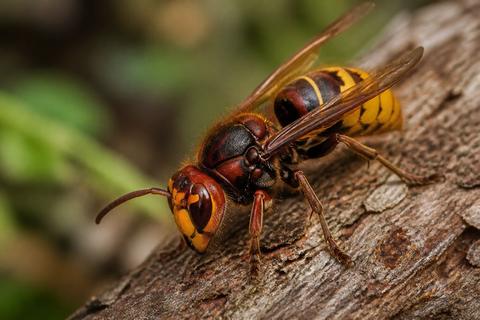
Size is the fastest field check. European hornet workers run up to an inch (25 mm) long, with queens reaching about 1.3 inches (35 mm), noticeably bigger and stockier than a paper wasp or yellowjacket. The body is thick through the thorax rather than narrow-waisted.
Coloration
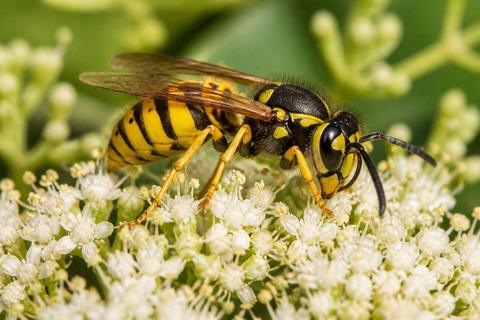
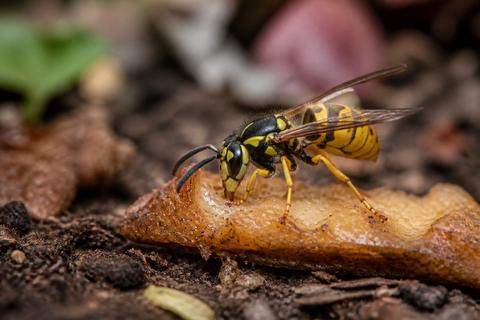
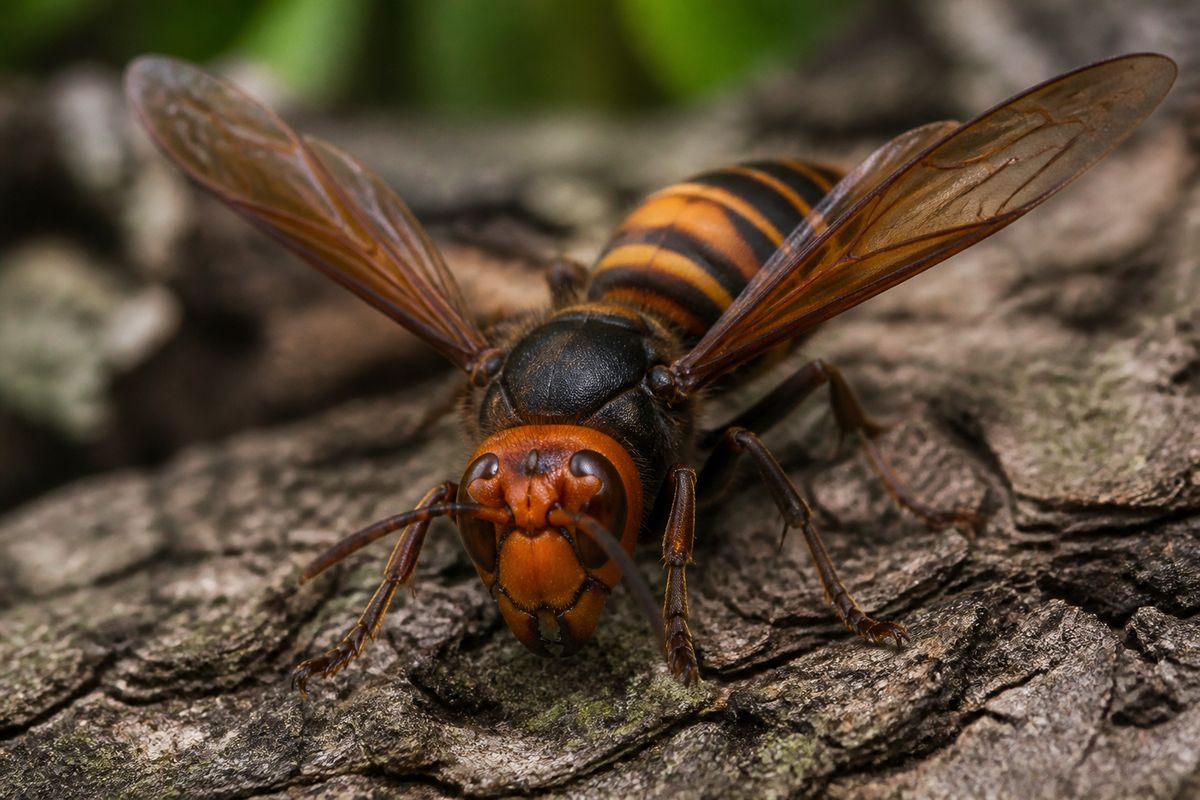
European hornets have a reddish-brown head and thorax with a black-and-yellow abdomen, the yellow segments broken by teardrop-shaped black marks. Bald-faced hornets look different: black body, white face, and white bands near the tip of the abdomen, no yellow at all.
Wings and Antennae
Both pairs of wings are amber-tinted and fold flat over the back at rest, broader in proportion to the body than a typical wasp's wings. Antennae are long, segmented, and elbowed partway down their length.
Stinger
The stinger is smooth, not barbed, so a hornet can sting more than once. Stinger shape alone won't identify the species since it looks similar across wasps, bees, and hornets.
Nest Shape and Material
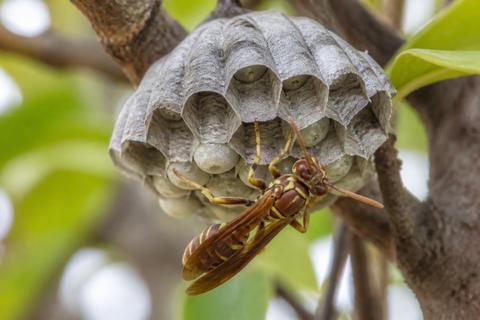
Hornets chew wood fiber and mix it with saliva to build paper-like nests, usually egg-shaped or round, with a single entrance hole near the bottom. European hornet nests are often hidden inside tree hollows, wall voids, or attics rather than out in the open. Bald-faced hornets build large, exposed, football-shaped nests hanging from tree branches or under eaves, sometimes over a foot long by late summer.
Colony Roles
A hornet colony has one queen, sterile female workers, and, late in the season, males and new queens. The queen lays eggs; workers forage, feed larvae, and expand the nest. A single insect flying alone and not defending a fixed nest site is more likely a solitary wasp, such as a mud dauber, than a hornet.
Seasonal Activity
- Spring: A mated queen that survived winter starts a small paper nest alone.
- Summer: Workers take over foraging and construction; the nest and colony size peak.
- Fall: The colony raises new queens and males before worker numbers collapse.
- Winter: The old nest is abandoned for good. Only newly mated queens survive, sheltering under bark or in leaf litter until spring.
Species You're Likely to See
European Hornet (Vespa crabro)
Reddish-brown and yellow, nests in cavities, active at night more than most wasps, and drawn to porch lights in late summer.
Bald-Faced Hornet (Dolichovespula maculata)
Black and white, not a true hornet, builds the large exposed paper nests most people picture when they hear the word "hornet."
Northern Giant Hornet (Vespa mandarinia)
Workers run just under 2 inches long and queens close to 2 inches, making this the largest hornet species on record. It is not established in the continental United States outside a small, since-eradicated pocket in Washington State, so a huge wasp-like insect seen elsewhere in the country is almost never this species.
Staying Safe While You Look
- Keep your distance. Identify from several feet away, ideally with binoculars, rather than walking up to the nest.
- Cover up if you need a closer look. Long sleeves, long pants, and closed shoes cut down on stings if a colony reacts.
- Call a professional for removal. A nest inside a wall void or attic, or an aggressive colony near a doorway, is a job for pest control, not a DIY spray can.
When a Nest Needs Professional Removal
An active nest within a few feet of a door, window, or path is worth having removed rather than monitored. Pest control technicians carry the protective gear and the right-timed approach, usually at dusk when foragers have returned, to clear a colony safely.